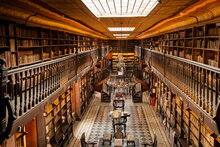
Early definitions of the Spanish word “archivo” describe the archive as a “public space”—a place where “original” documents and artifacts are preserved. It underscores the importance of preserving for posterity as a way to protect cultural heritage. These early definitions also emphasize the significance of treating what is preserved as something of utmost value. In the 18th century, it was also conceived as something that needed to be kept but “in perfect order” so that it is not lost or damaged. The act of care and vigilance with which something is kept was equally important. However, for contemporary critics such as Ann Laura Stoler, archives are not merely spaces that store documents, but they are also spaces that record the movements and emotions of the people mentioned in the documents. She adds, “they are records of uncertainty and doubt on how people imagined they could and might make the rubrics of rule correspond to a changing imperial world” (4). For this reason, we should read archival documents “against the grain” which means reflecting, paying attention to sound, emotions, and what is at first glance unintelligible. This course moves beyond conventional understandings of the colonial archive as a repository of knowledge to examine how the voices of marginalized groups—including women, Black, and Indigenous peoples—have been both preserved and silenced through archival practices. Through engagement with key theoretical readings, we will explore what constitutes an archive, how archival formations shape historical narratives, and how the concept of the archive has evolved over time. Particular attention will be given to the ways archives can serve as sites of both exclusion and resistance, while opening new possibilities for recovering and interpreting marginalized histories. Furthermore, we will examine current archival approaches in which different types of non-written materials are considered as materials to be preserved. How do we record visual images, sounds, oral traditions, movements, bodies, material objects, race, sexuality, emotions and identities in general, will constitute key points of discussion. In addition to hosting classes in the Rare Book and Manuscript Library at UIUC, this class will include guest lectures from UIUC librarians, and also experts on archival studies from outside the university. Primary texts to be analyzed include chronicles, natural histories, colonial newspapers, museum exhibitions, visual representations such as maps, graffiti and paintings, legal cases, digital catalogs, and literary anthologies. Class will be conducted in Spanish.
CRN: 47869
TIME: 2:00-4:50 PM Tuesdays
Pre-Requisite: Prerequisite for Undergraduate Students: SPAN 314 and SPAN 324 or consent of instructor.
Instructor: Mariselle Meléndez