This course explores how Mexican literature and culture have been conceived, experienced, and represented during the twentieth and twenty-first centuries. Through lectures and group discussions, we will follow a chronological examination of cultural production in Mexico, covering key periods such as the Revolución Mexicana, Modernidad, Guerra Sucia, and contemporary Mexico. We will reevaluate these cultural moments in light of contemporary topics, including indigenous studies, gender studies, border culture, and transnationalism.
The course employs methodologies from literary studies, cultural studies, and media studies to analyze a diverse range of cultural productions, including fictional narratives, essays, films, and visual art. The aim is for students to identify the practices of representation and self-affirmation within Mexico's multicultural population.
Students will engage with foundational scholars and writers, such as Nellie Campobello, Rosario Castellanos, Carlos Fuentes, Octavio Paz, and Juan Rulfo. Additionally, we will study contemporary novelists, artists, filmmakers, and musicians, including Jorge Fons, Alejandro González Iñárritu, Cristina Rivera Garza, and Juan Villoro, whose contributions enrich and reshape Mexican culture within a transnational context. The course will be taught in Spanish, and readings will be provided in English and Spanish.
M/W/F 12:00 pm – 12:50 pm, Location: 219 Gregory Hall
CRN: 53152
Instructor: Alejandro Ramírez Méndez
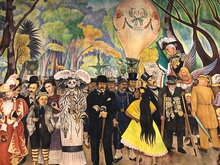
Course image caption: Diego Rivera, Sueño de una tarde dominical en la Alameda Central (1947)