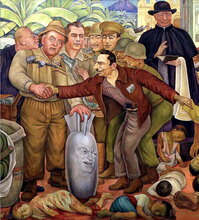
This course addresses the conflictive relationship between the United States and Latin America through literature and visual culture. In 1891, Cuban writer José Martí published his essay Nuestra América, referring to Latin America as opposed to the United States and Canada. Martí clearly states that toward the end of the 19th century, the independence of Latin America was not threatened by Europe but by the predominantly North American power, namely the United States of America. Martí calls all Latin American nations to remain united and to fight against the rising imperialist menace of the United States. José Marti’s essay will be one of the starting points of our course. From there, we will study various literary and cinematic works that approach cultural and political interventions of the United States in the region we know as Latin America. Through these works, we can see that the United States' hegemonic presence has used a wide range of strategies, from direct military invasion to subtle indoctrination through the spread of popular culture products.
M 4:00 pm – 6:50 pm, Location: G30 LCLB
CRN: 35627
Instructor: Alejandro Ramírez Méndez
Course image credit: Diego Rivera, La gloriosa victoria (1954)